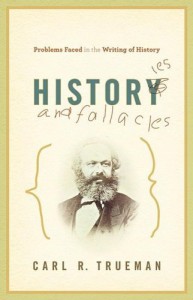
Carl R. Trueman, Histories and Fallacies: Problems Faced in the Writing of History
(Wheaton: Crossway, 2010), 176 (numbering added):
The names of
should be staples on everyone’s reading list.
by Andy Naselli
by Andy Naselli
Chris Morgan is Associate Dean of the School of Christian Ministries and Professor of Theology at California Baptist University. He is author or editor of several books, and it’s the last of these that we discuss below:


(Cf. my summary.)
(Cf. my interview with Chris on this book.)
Christopher W. Morgan, A Theology of James: Wisdom for God’s People (Explorations in Biblical Theology; Phillipsburg NJ: P&R Publishing, 2010).

I recently mentioned six books “that preachers, teachers, and students will consult first and with most profit when studying the book of James.” Now I would expand that list to include Chris’s two books (#s 3 and 8 above).
1. Your first sentence in the book is this: “Non-Christians do not read the Bible; they read Christians” (p. xiii). What do you mean by that, and what does this have to do with the theology of James?
My point is that our lifestyle as the church communicates God to the world. When the church embodies love, holiness, truth, unity, and consistency, people will receive a viable portrait of God. When the world sees the church as filled with pettiness, division, and self-promotion, unbelievers’ understanding of God is inevitably distorted.
James forthrightly calls for consistency in the church. Such church consistency is crucial for our effective communication of God, and thus effective mission.
2. You mention that James helps us deal with a tension many pastors feel. What is that tension, and what do you mean by it?
Many of us as pastors and church leaders are inspired by knowing what the church can and should be. [Read more…] about Interview with Chris Morgan on the Theology of James
by Andy Naselli
Jenni and I recently watched The Reason for God: Conversations on Faith and Life
(Zondervan, November 2010).
It’s a stimulating two-hour DVD with six sessions (and a corresponding discussion guide
):
Isn’t the Bible a Myth? Hasn’t Science Disproved Christianity?Keller models how to discuss Christianity with non-Christians. The DVD corresponds, of course, to Keller’s New York Times bestseller The Reason for God: Belief in an Age of Skepticism
(New York: Dutton, 2008).
D. A. Carson, “Editorial,” Themelios 34 (2009): 157:
In the world of Christian apologetics, I know no one more gifted in this Popperian form of argumentation than Tim Keller. Witness his The Reason for God: Belief in an Age of Skepticism (New York: Dutton, 2008). Keller manages to construct his opponents’ arguments in such a way that they are more powerful and devastating than when the opponents themselves construct them. And then he effectively takes them apart. No one feels abused, precisely because he has treated their stances more ably than they can themselves.
Related:
Cf. my review. See also the excellent corresponding DVD: The Prodigal God: Finding Your Place at the Table (Zondervan, 2009).

Cf. my review.
90-minute DVD. Eight Sessions with a corresponding discussion guide.


by Andy Naselli
D. A. Carson, Love in Hard Places
(Wheaton: Crossway, 2002), pp. 52–57 (numbering added):
Not all Christians face persecuting enemies, but all Christians face little enemies. We encounter people whose personality we intensely dislike—
- an obstreperous deacon or warden or bishop;
- a truly revolting relative;
- an employee or employer who specializes in insensitivity, rudeness, and general arrogance;
- a business competitor more unscrupulous, not to say more profitable, than you are;
- the teenager whose boorishness is exceeded only by his or her unkemptness;
- the elderly duffers who persist in making the same querulous demands whenever you are in a hurry;
- the teachers who are so intoxicated by their own learning that they forget they are first of all called to teach students, not a subject;
- the students so impressed by their own ability or (if they come from certain cultures) so terrified by the shame of a low grade that they whine and wheedle for an “A” they have not earned;
- people with whom you have differed on some point of principle who take all differences in a deeply personal way and who nurture bitterness for decades, stroking their own self-righteousness and offended egos as they go;
- insecure little people who resent and try to tear down those who are even marginally more competent than they;
- the many who lust for power and call it principle;
- the arrogant who are convinced of their own brilliance and of the stupidity of everyone else.
The list is easily enlarged. [Read more…] about Loving People You Don’t Like
by Andy Naselli
Don Carson, who doesn’t sharply distinguish between popular and high culture, opens his book Love in Hard Places
(2002) by summarizing some points from The Difficult Doctrine of the Love of God
(2000):
First, popular culture saunters between a sentimental view and an erotic view of love. The erotic view is fed by television, movies, and certain popular books and articles; the sentimental view is nurtured by many streams, some of which we shall think about as we press on, but the result is a form of reductionism whose hold on the culture is outstripped only by its absurdity.
- Applied to God, the sentimental view generates a deity with all the awesome holiness of a cuddly toy, all the moral integrity of a marshmallow. In the previous lectures, I briefly documented this point with examples from films and books.
- Applied to Christians, the sentimental view breeds expectations of transcendental niceness. Whatever else Christians should be, they should be nice, where “niceness” means smiling a lot and never ever hinting that anyone may be wrong about anything (because that isn’t nice).
- In the local church, it means abandoning church discipline (it isn’t nice), and in many contexts it means restoring adulterers (for instance) to pastoral office at the mere hint of broken repentance. After all, isn’t the church about forgiveness? Aren’t we supposed to love one another? And doesn’t that mean that above all we must be, well, nice?
- Similarly with respect to doctrine: the letter kills, while the Spirit gives life, and everyone knows the Spirit is nice. So let us love one another and refrain from becoming upright and uptight about this divisive thing called “doctrine.” (pp. 11–12; numbering added)
by Andy Naselli
D. A. Carson, The Gagging of God: Christianity Confronts Pluralism
(Grand Rapids: Zondervan, 1996), 470 (emphasis in original):
Churches that are faithful to the apostolic gospel are sometimes also the ones that are loyal to a culture becoming increasingly passé. In such a situation cultural conservatism can easily be mistaken for theological conservatism, for theological orthodoxy. In an age of confusing empirical pluralism and frankly frightening philosophical pluralism, in an age that seems to be stealing from us the Judeo-Christian worldview that prevailed for so long, it is easy to suppose that retrenchment and conservative responses on every conceivable axis are the only responsible courses for those who want to remain faithful to the gospel.
In various ways I have tried to show in this volume that such a course is neither wise nor prophetic. Sometimes it is not even faithful. The church may slip back into a defensive, conservative modernism that is fundamentally ill-equipped to address postmodernism.
by Andy Naselli
D. A. Carson, The Gagging of God: Christianity Confronts Pluralism
(Grand Rapids: Zondervan, 1996), 46:
I do not want to succumb to the elitism that makes sharp distinctions between popular and high culture.
[Footnote] See, for example the telling review of Kenneth A. Myers, All God’s Children and Blue Suede Shoes: Christians and Popular Culture
(Westchester: Crossway, 1989), written by William Edgar and published in Westminster Theological Journal 53 (1991): 377–80.
From Bill Edgar’s review:
Despite the many attractive features of this book, and the welcome emphasis on apologetics for the ordinary modern person, this reviewer has serious reservations about some of its basic assumptions. The most questionable is the concept of popular culture itself. Myers divides the cultural world up sharply between those things that belong to basically good high culture, and those that belong to basically problematic popular culture. He equates high culture with tradition, and attributes to it such characteristics as focusing on timelessness, encouraging reflection, requiring training and ability, conforming to the created order, referring to the transcendent, etc. (p. 120). By contrast, popular culture focuses on the new and instantaneous, is a leisure activity, appeals to sentimentality, is individualistic, and tends toward relativism. [Read more…] about Popular and High Culture
by Andy Naselli
Carl Trueman wrote this in March 2010 after the Tiger Woods saga:
Some years ago I found the argument of John Armstrong’s excellent book The Stain That Stays utterly convincing: post-conversion adultery, unlike other sins, is the one which permanently excludes one from leadership or office-bearing in the church; of course, there is forgiveness and restoration to fellowship for those who repent and ask for such; but as far as leadership goes, it’s over. I still point to that book, especially the superb last chapter on avoiding sexual sin, as required reading for men going in for ministry.
I promptly added that book to my reading list, and I finally read it this week.
John H. Armstrong. The Stain That Stays: The Church’s Response to the Sexual Misconduct of Its Leaders. Fearn, Scotland: Christian Focus Publications; Reformation and Revival Ministries, 2000.

Since writing this book, John Armstrong has shifted towards a big-tent evangelicalism and away from the conservative evangelical circles he used to be a part of (hence the foreword by Kent Hughes and endorsements by Al Mohler, John MacArthur, and Tom Nettles).
The book’s style is a bit cumbersome, but it’s an edifying read about a deadly serious issue. Here are Armstrong’s eight suggested ways that pastors should plan to prevent sexual sin (pp. 174–81):
I don’t agree with Armstrong’s thesis, but his book rightly treats sexual sin soberly. I find D. A. Carson’s argument more compelling: “Do You Think That a Fallen Christian Leader Can Ever Be Restored? If Not, Why Not? But If So, under What Conditions?” The Southern Baptist Journal of Theology 4.4 (2000): 87–89.
Update: Cf. Andrew David Naselli, “Is Every Sin Outside the Body except Immoral Sex? Weighing Whether 1 Corinthians 6:18b Is Paul’s Statement or a Corinthian Slogan,” JBL 136 (2017): 969–87. In 1 Cor 6:18b–c, Paul writes, “Every sin, whatever a person commits, is outside the body, but the sexually immoral person sins against his own body.” My essay weighs whether 1 Cor 6:18b is Paul’s statement or whether Paul is quoting a Corinthian slogan, and it concludes that the second view is more plausible (contrary to how John Armstrong argues in the above book).